How Lake-Effect Winters Break Automatic Sliding Door Tracks
Automatic sliding doors carry Buffalo’s retail, medical, and office traffic day in and day out. When winter hits Erie County, those doors face a harsher load than in most markets. The combination of lake-effect snow, wind off Lake Erie, freeze-thaw cycles, and road salt beats up tracks, rollers, and sensors. That is why automatic sliding door repair in Buffalo requires more than generic business door repair. It calls for AAADM-certified judgment, parts on the truck, and a plan that respects how Western New York winters actually fail the hardware.
Why Buffalo’s winter breaks sliding door tracks faster
Buffalo sits at the east end of Lake Erie in ASHRAE Climate Zone 5A. From November through March the city can see 95 to 100+ inches of lake-effect snow with individual events that bury entrances in a day or two. Wind at Buffalo Niagara International Airport averages about 12 mph with routine winter gusts far higher. These conditions load doors in ways most national specs do not fully cover. Ice packs into tracks. Salt sits in bottom rails and corrodes guide hardware. Wind pushes panels laterally while the operator tries to move them forward. Each of these forces accelerates wear on track, rollers, belts, and sensors.
An automatic sliding door track is the aluminum or stainless channel that the door’s hanger rollers ride along. Those rollers, also called trolley assemblies, carry panel weight and guide the door. A bottom guide shoe, which is a plastic or nylon guide fin that runs in a floor groove or on a threshold guide, prevents the panel from swinging. When ice builds in the lower guide, the panel binds. When salt sits in the upper track, the rollers grind it in like sandpaper. That is why Buffalo tracks wear grooves sooner, and why rollers develop flat spots or seize.
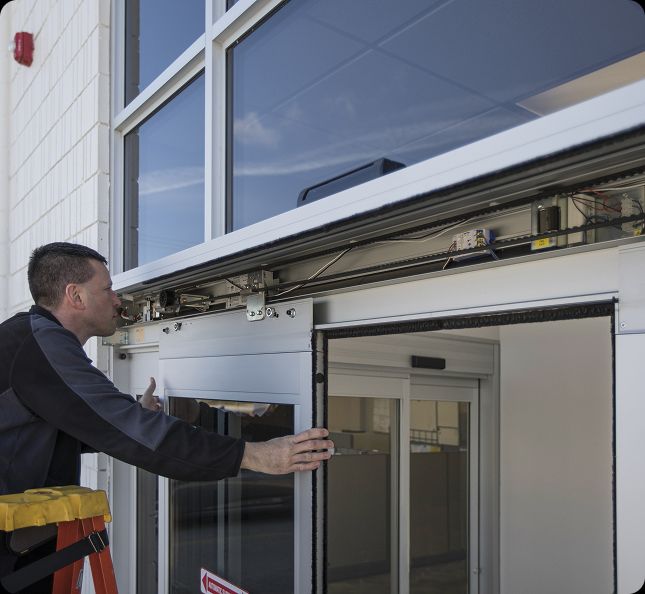
What fails first on automatic sliding doors in lake-effect events
When a band of snow drops fast accumulation on Main Street, Elmwood Avenue, or Hertel Avenue, the entry takes the hit. Snow and slush travel in on shoes, wheels, and carts. Doors cycle hundreds to thousands of times per day on busy corridors, so failures show quickly. Typical early-stage symptoms are simple to spot and should be handled before a shutdown.
Track and roller distress from ice and salt
Ice in the lower guide makes the panel chatter. Chatter is rapid vibration as the guide fights obstruction. Chatter deforms the guide shoe and loosens fasteners. At the top, salt crystals drop from boots and then wick into the track. Rollers crush those crystals and score the raceway. Scored tracks raise rolling resistance and make the operator work harder, which raises motor and belt load. The cycle compounds until the system faults or stalls.
Operator and belt strain during wind gusts
Automatic sliding door operators are the head units that contain the motor, control board, and drive belt. In a wind gust, the panel becomes a sail. The operator senses resistance and either current-limits or faults. Repeated gust loading stretches the belt and loosens clamps. A stretched belt slips on acceleration and throws the learned open and close positions out of tolerance. Doors then rebound, stall halfway, or stay open. In Buffalo gusts push harder and more often, so belts and clamps need closer inspection schedules.
Sensor confusion in blowing snow
Sliding doors use presence and activation sensors to decide when to open and how far. Presence sensors keep the door from closing on a person. Activation sensors tell the door to open. Blowing snow and drifting can trigger activation sensors all day by mimicking motion. Road film from plows and salt can coat protective lenses and reduce presence sensitivity. The result is doors that hang open, short-cycle, or close too soon. That drives complaints and wastes heat in a 14202 Downtown Buffalo or 14203 Medical Corridor lobby.
How an AAADM-calibrated approach reduces winter downtime
AAADM stands for American Association of Automatic Door Manufacturers. AAADM certification means a technician is trained to service automatic doors to the current ANSI standards that govern safety. For sliding doors that is ANSI A156.10. It sets how activation and presence sensing should work and outlines performance expectations. Buffalo facilities that run Record USA, Stanley, Besam ASSA ABLOY, or Horton Automatics sliding systems need service according to these standards. That service plan looks different heading into a Buffalo winter than it does in milder markets.
Preventive work in September and October delivers the highest payoff in Western New York. Summer grime is cleared from tracks and rollers. Threshold drains and weeps open up to move meltwater away. Upper track covers come off for a thorough vacuum and solvent wipe to remove embedded salt and grit. Belts get checked for stretch and clamp bite. Control boards get a cold-start review so speed and torque profiles https://s3.us-east-005.backblazeb2.com/home-fix-hub/commercial-doors/erie-county-commercial-glass-door-repair-2026.html match winter load. Presence and activation sensors get real-world pass testing with carts, wheelchairs, and walkers to support ADA access during storms. ADA, the Americans with Disabilities Act, limits interior door opening force to 5 pounds for low-energy swing operators. While sliding doors do not share that exact limit, the intent is accessible passage. Keeping cycle performance within spec during cold starts supports that aim.
Buffalo building archetypes that make sliding doors work harder
Local door performance ties closely to the building around it. Historic Main Street retail in Elmwood Village or Allentown often has shallow floor pockets and settled slabs. That pushes guide rail alignment out and worsens winter drag. Mid-century strip plazas across Cheektowaga, Amherst, and West Seneca often retrofit modern sliding packages into older storefront frames. Those frames lack modern drainage paths. Meltwater stays under the panels and freezes at night. Big-box stores along Walden Avenue, Transit Road, and Niagara Falls Boulevard run long, heavy panels with high cycle counts and cart traffic. That punishes rollers and belts. Medical entrances around the 14203 Medical Corridor and the Buffalo Niagara Medical Campus run strict uptime needs and stricter sensor validation because of patient mobility. Each of these sites needs a slightly different winter setup.
Automatic sliding door components that fail in Buffalo and why
Most sliding failures here trace to five parts. Each part is simple to name and easy to understand in plain terms, which helps facility teams plan service before a shut door disrupts operations.
- Track: The channel the top rollers ride. Pitted tracks raise rolling resistance and twist hangers. Winter grit accelerates pitting. Rollers or trolley assemblies: The wheels that carry door weight. Flat spots from grit cause thumping and speed fluctuation. Bottom guide and threshold: The fin and groove that keep the panel from swinging. Ice here stops the panel and snaps fasteners. Drive belt and clamps: The belt moves the panel. Stretch or slip creates stalls, rebound, or open-door faults in gusts. Sensors: The devices that see people. Dirty lenses and drifting snow cause false opens or missed presence detection.
Doors in South Buffalo and Lackawanna that face parking lots collect more salt. Downtown doors near Canalside and the Cobblestone District see more wind. Airport-zone properties near KBUF in Cheektowaga and 14225 deal with constant tracked-in deicer. Each pattern has a predictable impact on those five parts.
Brands, parts, and what matters in a Buffalo service truck
Most Buffalo sliding operators come from Record USA, Stanley, Besam ASSA ABLOY, or Horton Automatics. Record USA systems are common in medical and office facilities. A-24 Hour Door National Inc. Is an authorized service partner for Record brand entrance solutions. Stanley Dura-Glide and MC521 Pro show up widely in retail. Besam ASSA ABLOY SL500 and Horton Profiler series appear in healthcare and retail. All use the same core elements. A motor turns a drive belt. A control board interprets sensors and sets speed, acceleration, and hold-open time. Hanger rollers set height and carry load. The track guides movement and holds covers.
Buffalo service trucks should carry rollers, belts, clamps, sensor heads, guide shoes, threshold guides, and the tools to clean and re-seat tracks. Trucks should also carry BEA or Optex activation and presence sensor models that match common footprints, so a failed eye can be swapped in the same visit. Stock matters in Western New York. The difference between a warm, functioning vestibule and a boarded opening during a storm is often whether the belt, hanger, or sensor is on the truck at 8:00 a.m. On a Friday.
How wind and cold change the setup of a sliding door
Sliding door control boards let a technician tune speed, acceleration, braking, and hold-open time. In Buffalo winter, these values often need a colder baseline. Faster acceleration may help beat wind push, but too fast can outrun presence sensing. Higher close force may move a stiff panel, but too high can violate ANSI A156.10 safety intent. The right balance is a field judgment. That is why AAADM-certified technicians test with real traffic. They walk carts and wheelchairs through the detection zones. They check for blow-open faults and hold-open drift during gusts. They return during a freeze to confirm performance when hydraulic fluids in closers and operator gear lubricants thicken.
Hydraulic closer fluid is relevant even at sliding entrances. Many vestibules pair a sliding outer door with a swing inner door that uses a hydraulic closer. Hydraulic closer fluid thickens below about 20 degrees Fahrenheit. Thick fluid loses damping and either slams or refuses to close until the area warms. Buffalo sees temperatures at or below this level often. A fall visit to set both the sliding operator and the inner swing closer reduces winter complaints and protects glass and hardware on both doors.
Shareable Buffalo-specific failure patterns facility managers watch
Facility teams across Elmwood Village, Allen Street, and Chippewa Street know this pattern well. After a heavy lake-effect event, the morning crew shovels and salts the sidewalk. Traffic starts. By mid-morning the sliding door track sounds gritty. By noon the door struggles to reach full open. By 2 p.m. The panel stalls half open as roller flats grow. The cost to restore now includes track reconditioning or replacement, roller sets, and cleanup. If the door faults open during a wind gust, the vestibule loses heat and energy costs spike. If the door fails closed, traffic flow stops and an employee must manually manage entry. Proactive track cleaning and roller inspection in fall, plus a mid-winter service touch if a major storm cycle hits, avoids that chain reaction.
Buffalo’s wind also forces a unique concern. At KBUF and along the waterfront, gusts to 40 to 60 mph during major storm events push on sliding panels and can rack hanger arms. A racked hanger changes roller angle. That scrubs the track and starts a wear groove. The fix is a careful re-square of the hanger geometry and, in severe cases, a new track segment.
Automatic sliding doors on Buffalo medical and ADA routes
Hospitals and clinics in the 14203 Medical Corridor and on the Buffalo Niagara Medical Campus run more stringent standards. Sliding doors on patient routes must open wide enough for stretchers and gurneys. Presence sensing must cover the full path to prevent contact. In winter, lens films and snow spray from transport wheels can confuse sensors. Maintenance teams schedule AAADM checks more frequently through the cold months. Where a vestibule mixes sliding and swing doors, ADA door approaches must stay clear of snowbanks. Automatic swing operators governed by ANSI A156.19 need checks on opening force and time-to-close profiles after each major storm.
Commercial corridors and cycle counts that drive wear
Daily cycle counts on Elmwood Avenue, Hertel Avenue, Main Street Amherst, and Transit Road get high. Busy days yield hundreds to thousands of cycles. Each cycle drives wear in rollers and belts. In calmer climates, these parts last longer because contamination is lower. Buffalo foot traffic drags salt crystals in for months. That is why a Buffalo operator that would run three to five years elsewhere may need attention in half that time without seasonal cleaning. A simple post-storm wipe of the track cover lips and threshold guides by janitorial staff helps. It will not replace technical service, but it slows the grind that destroys hardware before its expected life.
How automatic sliding doors interact with aluminum storefront frames
Most Buffalo storefronts run Kawneer, Tubelite, YKK AP, Vistawall, or US Aluminum systems. These are aluminum storefront frames that hold glass and support door openings. Sliding packages often mount to structural headers applied over these frames. When frames shift from freeze-thaw or slab heave, the header gets out of level. A small pitch makes the belt fight gravity and causes drift. A-24 Hour Door National Inc. Technicians know how to diagnose out-of-level headers and frame racking as part of automatic sliding door repair. If needed, they shim and secure the operator track or call out upstream storefront repairs where a mullion has moved.
Some entries pair sliding doors with balanced or heavy-duty swing doors such as Ellison Bronze at stadiums or civic venues. Those have their own winter behavior, but both types share salt and wind load. Where panic hardware is present on adjacent swing doors, models like Von Duprin 98/99 series must remain free for egress under NFPA 101 Life Safety Code and IBC Chapter 10 Means of Egress. That code layer sits over every service decision, winter or not.
What an effective Buffalo winter service visit looks like
A productive winter-focused visit does more than clean. It verifies safety and prepares for the next storm. It is hands-on, practical, and fast, because doors cannot stay down long in 14202 Downtown or 14221 Williamsville retail during peak hours.
- Open and clean the full upper track, not just the cover lips, until the roller raceways are clear. Vacuum and flush the lower guide path and threshold drains so refreeze is less likely overnight. Inspect and replace rollers that show flats, wobble, or seized bearings before they score the track. Check belt tension and clamp bite, then recalibrate open and close positions to match winter load. Clean and re-aim presence and activation sensors, then function-test with real traffic devices.
Most of this work completes in one visit if the service truck carries the right parts. That is why stocked inventory is a core Buffalo advantage. A-24 Hour Door National Inc. Fields service trucks with common Record USA parts, plus sensors, belts, rollers, and cleaners, so a 14228 Amherst or 14075 Hamburg property is not waiting for a second appointment while a storm bears down.
Material choices and installation decisions that pay off in Buffalo
Automatic sliding door installation choices matter years later. Track alloy, roller wheel material, and threshold design change how the entrance handles salt and ice. Stainless steel threshold guides resist corrosion better than standard aluminum in high-salt sites. Hardened track raceways fight grooving. Rollers with sealed bearings and shielded races keep grit out longer. On mixed-traffic sites with grocery carts, a slightly higher guide fin can reduce repetitive impact. Small choices in commercial door installation reduce service calls through winter and hold operating costs down for properties in Kenmore, Tonawanda, and North Tonawanda.
Energy loss, snow infiltration, and vestibule strategy
Vestibules help a sliding entrance fight Buffalo wind. They also present a tuning problem. If the outer sliding door hangs open from a false activation during a whiteout, the inner door takes the pressure and sensor confusion. The fix is thorough sensor shielding and aiming, along with a smart hold-open timer for winter. Shorter holds reduce infiltration on quiet days. Longer holds ease heavy waves of traffic at KeyBank Center events or on game days in Orchard Park near Highmark Stadium, but they should not become default. Regular reviews of settings as seasons change keep energy loss and sensor burdens low.
Emergency response and board-up when sliding doors fail during storms
Not every failure gives a warning. A belt can snap. A trolley bolt can shear. A sensor can die in the middle of business hours at 14204 Broadway-Fillmore or 14222 Elmwood Village. When that happens during a storm, the site needs fast dispatch, safe securing, and a return to operation. A-24 Hour Door National Inc. Dispatches 24/7 across Buffalo and Western New York from 344 Sycamore Street in the 14204 corridor. Trucks carry temporary securing hardware and board-up materials if glass breaks. Where glass is intact, technicians can pin panels in a safe position and restore operation with a new belt, roller, or sensor often in the same visit. If impact damage or a break-in at a sliding entrance shatters glass, emergency board-up stabilizes the storefront until tempered or laminated glass arrives for next-day replacement when sizes are standard.
Cost dynamics in Buffalo winter and why timing matters
Facility budgets feel winter service. General-market ranges for sliding door repairs vary by brand, part, and scope. A minor sensor swap and recalibration can fall on the low end. Track replacement and multiple trolley sets can land higher. Emergency after-hours calls with board-up will add to cost. An exact price always requires an on-site estimate because each entrance has unique brand, size, and condition. What remains consistent is the timing effect. A fall service visit that restores track smoothness and replaces borderline rollers is almost always cheaper than a mid-storm failure that grinds the track, stretches the belt, and forces a same-day scramble. That is the Buffalo math that pays off every season.
Where sliding doors and other openings converge on Buffalo sites
Many Western New York properties run more than sliding doors. There are swing storefront doors with LCN 4040 or Norton 8000 series closers. There are back-of-house rolling steel service doors by Cornell or Cookson. There are Hormann sectional overhead doors on docks in the Tonawanda industrial belt and West Seneca warehouses. There are high-speed roll-up doors by Rytec or Albany in refrigerated areas. A-24 Hour Door National Inc. Services all of these categories, with authorized service on Hormann commercial garage doors and deep familiarity with aluminum storefront brands like Kawneer, Tubelite, YKK AP, Vistawall, and US Aluminum. That multi-system view helps solve sliding door issues that are actually caused by vestibule pressure, slab heave, or adjacent hardware settings.
Local coverage area and winter logistics
Buffalo properties from Downtown and the Theatre District to Larkinville and the Hydraulics see crews quickly because dispatch starts at 344 Sycamore Street. Coverage spans Cheektowaga, West Seneca, Hamburg, Orchard Park, East Aurora, Lackawanna, Kenmore, Tonawanda, North Tonawanda, Amherst, Williamsville, Clarence, Lancaster, and Depew. Zip codes like 14202, 14203, 14204, 14213, 14215, 14220, 14222, 14225, 14228, 14150, 14221, 14075, and 14127 are all within standard service range. Winter staging matters. Trucks carry salt-safe mats and entry protection to keep floors clean while the work proceeds. That helps sites stay open and safe while the door is serviced.
Why Buffalo businesses call A-24 Hour Door National Inc. For automatic sliding door repair
A-24 Hour Door National Inc. Has served the Western New York commercial door market for more than 30 years from its Buffalo base. The company dispatches 24/7 and fields AAADM-certified technicians for automatic door work, including authorized service on Record brand entrance solutions. Service trucks are stocked to complete most automatic sliding door repair in one visit, with OEM replacement parts backed by manufacturer warranties. The operation is fully insured and operates from 344 Sycamore Street, Buffalo, NY 14204. Payment options include Cash, Check, Mastercard, Visa, American Express, and Net 30 for qualified customers. The company’s direct-dispatch model covers Buffalo, Cheektowaga, West Seneca, Hamburg, Orchard Park, East Aurora, Lackawanna, Kenmore, Tonawanda, North Tonawanda, Amherst, Williamsville, Clarence, Lancaster, and Depew. The Google Business Profile shows a strong track record, currently cited by third-party sources as 4.8 with 59 Google reviews.
To schedule automatic sliding door repair, to book a fall pre-winter service visit, or to request 24/7 emergency dispatch anywhere in Buffalo or Erie County, call A-24 Hour Door National Inc. At (716) 894-2000. The national line is (800) 884-4440. Online requests can be made at https://a24hour.biz/buffalo/. Record brand entrance solutions authorized service. Hormann commercial garage door authorized service. Satisfaction guarantee, OEM parts, and AAADM-certified safety checks on every automatic door job.